

Work · Case study
A Bias-Backed Brand Migration
How a Coglode-and-Octalysis evaluation became the design language for The Handel Group’s Inner.U redesign — now shipped and live at inneru.coach.
The brief
Merge two brands — Inner.U and HG Life — into one funnel, elevate the visual brand overall, and reduce the friction on Inner.U’s self-serve flow.
The Handel Group had two web presences doing two jobs: HG Life as the B2B and content-marketing surface, and Inner.U as the self-serve platform their content-driven funnel pointed at. The two brands had grown up looking different, and the company wanted to bring them visually together while keeping the funnel mechanics intact and lighter to move through. The contract was for mid-fidelity wireframes. The team came in with several sites they admired and an honest acknowledgment that they weren’t sure how to get from inspiration to direction.
Backing yourself up
They were smart people. I was a little intimidated. So instead of bringing opinions, I brought a framework.

I’d just come off a six-month deep dive into gamification — specifically Yu-kai Chou’s Octalysis framework and Coglode’s library of cognitive-bias “nuggets.” Coglode catalogs behavioral biases with implementation patterns; Octalysis maps motivation into eight core drives — Meaning, Empowerment, Social Influence, Ownership, Scarcity, Unpredictability, Avoidance, and Accomplishment. I hadn’t yet had the right project to deploy them on. This was the right project.
The meta-move was the move itself: the evaluation was anchored in the Authority bias — citing a recognized methodology to ground judgment in something other than taste. Walking into the room with named frameworks behind every observation turned “do you like this?” into “is this the mechanic we want here?” — a different conversation entirely.
The evaluation
I took full-page screenshots of every funnel they admired — plus three I thought were sharper analogs to their actual goal — and tagged every section with the cognitive bias it was leveraging.
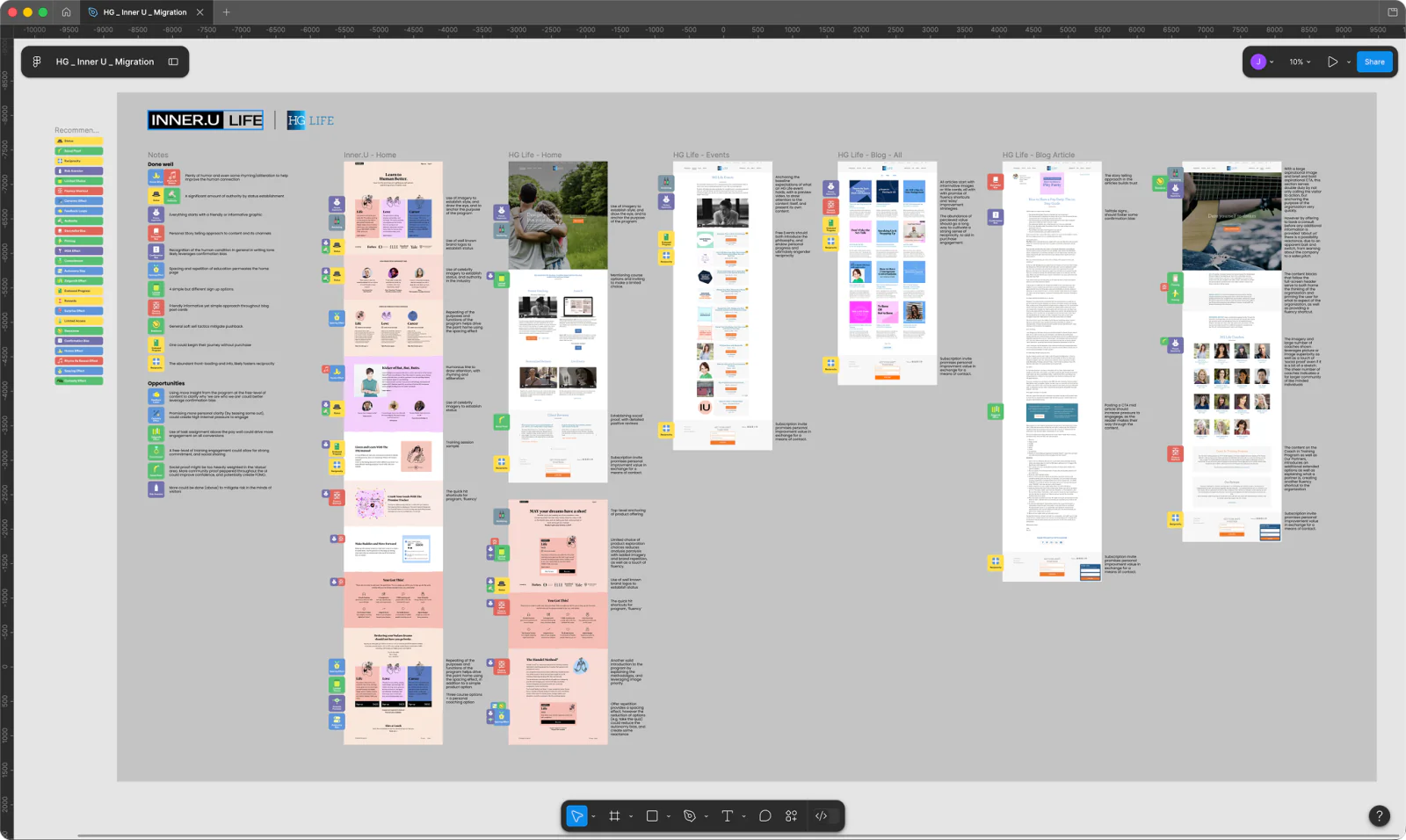
Going section by section, I attached Coglode nugget chips to every block of every page: Social Proof here, Anchoring there, Spacing Effect across the testimonial layout, Risk Aversion in the pricing CTA, Endowed Progress in the program intro. Same exercise on Inner.U and HG Life as they existed at the time, so every comparison was apples to apples — what the analogs were doing, what the client was already doing, and where the gaps lived.
When we presented the eval, the client had never seen anything quite like it. (Neither had I. I didn’t let on.) After that first session, they asked if we could record the rest of the engagement so the conversations could be shared internally.
From eval to wireframes
I deconstructed the strongest sections into super-low-fi wireframes — keeping the nugget chips attached — and rebuilt the funnel from the winners. Then I gut-checked the whole thing against Octalysis.
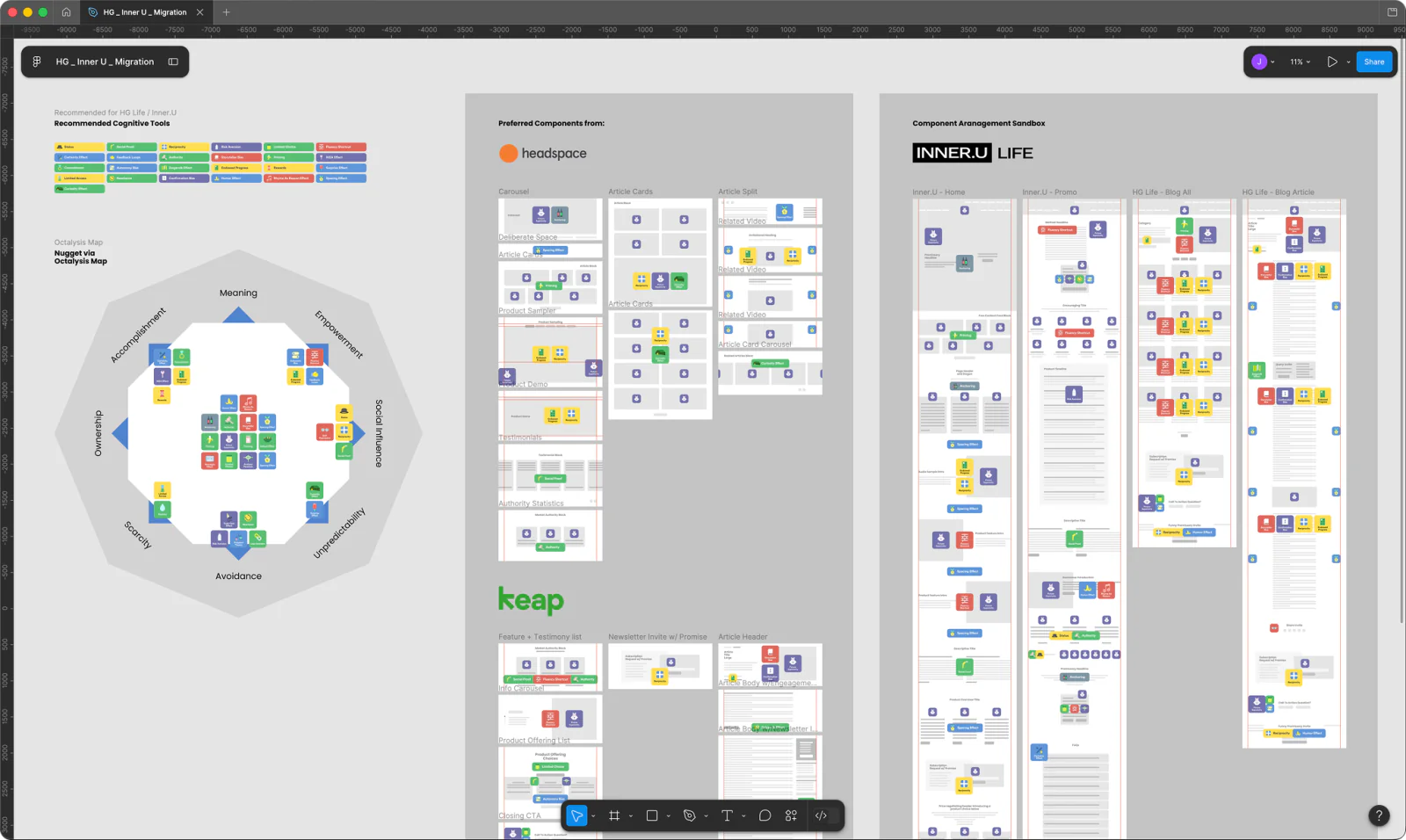
The wireframes that came out of the eval weren’t designed to look like anything in particular — they were stripped to their structural choices, with the bias chips still hanging off every block. That way every design decision in the room was traceable: we’re using Endowed Progress here because that’s what worked on a competitor’s onboarding; we’re using Limited Choice on pricing because Autonomy Bias was creating analysis paralysis on the existing page.
Once client direction settled on which wires to take forward, I mapped the surviving nuggets onto the Octalysis octagon as a final gut check. The question Octalysis answers is are we pushing the right human buttons in the right place in the journey? — Meaning early, Accomplishment in the middle, Social Influence in the proof, Scarcity at the close. The map was a way to spot motivational holes the bias work hadn’t surfaced on its own.
The room kept getting bigger
By the final presentation, members of the marketing team had asked to join — partly to see, partly to grill us on the approach.
It’s one I’d take any day. The audience grew across the engagement: from a working group, to recorded working sessions, to a packed final review with the marketing team in the room ready to pressure-test the logic. The bias-and-Octalysis framing held up under questioning, because every section had a because attached — not a taste-based one.
What shipped
Mid-fi wireframes delivered. Inner.U was redesigned and built to spec, and is live today at inneru.coach. HG Life’s free content moved into Inner.U’s free tier.
The two-brand-into-one plan executed on the Inner.U side — funnel redesigned, free HG Life content migrated in, the upgraded experience pointing at the self-serve platform the same way the strategy had intended. HG Life’s standalone marketing surface stayed in its older treatment — the part of the plan the team chose not to take all the way, which we’d half-anticipated by the end of the engagement. What landed, landed.
What’s notable a couple of years on: any changes the team has made since are nearly invisible against the original. The grammar of biases-per-section is stable enough that incremental updates inherit it automatically. That’s the strongest indicator the framework was doing real work, not decoration.
What this was actually about
Every section had a reason behind it that wasn’t “looks good.” That accountability is the work.
The bias map and the Octalysis gut check weren’t process for process’s sake. They changed the kind of conversation the room was having — from preference to mechanism, from taste to function, from this is what I’d do to this is what this section is supposed to do. That’s the kind of redesign brief worth taking. And it’s the substrate I think any brand that takes its funnel seriously should have under it — whether they ever see the diagrams or not.
Of every client engagement I’ve led, this one is still the one I’d point at first.