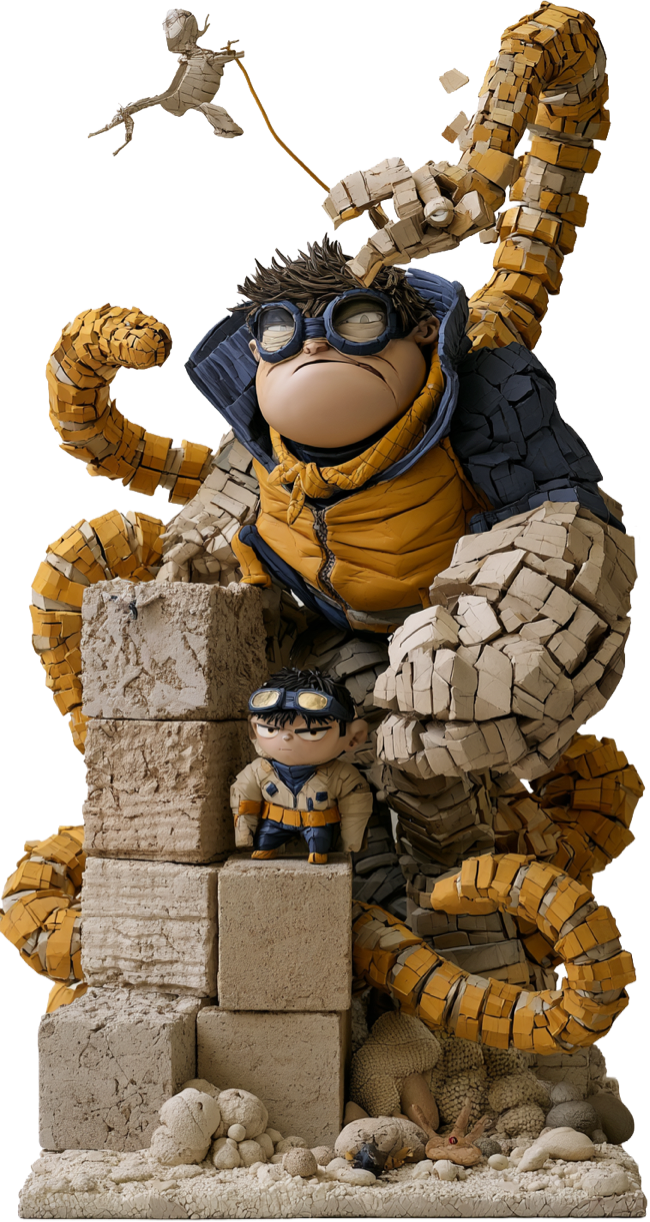


If you’re reading this, the new abrevd.com is live. What was a flat HTML deployment is now a proper JAMstack build with a real blog and multi-theme support — the kind of infrastructure upgrade I’ve been meaning to do for months and kept deferring, the way you defer anything that’s important but not urgent.
So why now? I’ll be honest: because the clock ran out.
Today is the last day of my trial access to Claude Fable 5, Anthropic’s new frontier model, and I wanted to squeeze every drop out of it before it moved out of reach of my subscription. Rebuilding this site during the trial window was partly a stress test of what better-than-me inference feels like when it’s pointed at a real project, and partly — let’s be honest — just for fun. There are worse reasons to ship. I’m not sure there are better ones.
The model isn’t going anywhere. Neither am I.
Fable 5 leaving casual, everyday reach doesn’t mean it’s leaving. It’s still there behind the API, and based on my own usage math, I’ll slow down for a stretch and then call on it exactly when its particular capabilities are worth paying for. I have a trading card game project — more on that in a minute — with a long road ahead of it, and Fable 5 has been instrumental in resurrecting it. When that project hits its critical phases before release, I’ll be back at the frontier, invoice in hand, happily.
And here’s the thing the AI-optimist crowd says that I’ve watched come true over and over: this is the worst it’s ever going to be. What blows our minds about Fable 5 today will trickle down into simpler models, replacement models, local models. It’ll be table stakes before we’ve finished being impressed by it. The competitive field is crowded and strong, the local model harnesses get better monthly, and the entire stack underneath all of this — chips, compute, infrastructure — is being rebuilt in real time. Losing convenient access to one model for a while is not a loss. It’s a preview.
The arms, not the clone
There’s a question I think everyone gets wrong about this technology, and it’s usually phrased as: how can I get AI to do my job for me?
Wrong question. The right ones are: How can AI help me do more? Can it help me do better? Can I reach a higher level of polish and intent? Can I try new things — can I try more things? Can I attempt things I would never have attempted before?
I think of AI as Doc Ock’s arms, not an android clone of myself. The arms don’t replace the scientist. They extend him into places his own two hands can’t reach, while he stays exactly who he is at the center of the rig. I’m convinced that’s the only healthy way to engage with this stuff: additional talent, not alternative talent. AI lets me stay focused on what I’m already practiced at, do more of it, and sharpen my own skills along the way — while the arms handle the reaching.
Case in point: the trading card game.
It started as a joke at a party. My brother off-handedly said the characters in the UFO disclosure space should have trading cards, we chuckled, and ordinarily that’s where it would have ended — a good bit, dead by morning. But I’m a designer and a heavy Midjourney user, and somewhere between the laugh and the next round I thought: no, wait. We could actually do this.
Here’s what I brought to that project: an interest in the subject matter, and thirty years of design instinct for establishing a look, a feel, a vibe. Here’s what I did not bring: any real understanding of TCG mechanics, game balance, or the deep craft that people devote whole careers to. Ten years ago, that gap kills the project at the party. Today, every one of those gaps could be — and has been — filled by AI. Not by replacing me, but by extending me into the areas I know too little about, while I do the thing only I was going to do anyway: make it look and feel like something.
That’s the whole model. Inventory your assets, not your deficits. The question was never “am I qualified to make a trading card game?” The question was “what do I already have, and what can the arms reach?”
Assets over deficits, at every scale
I’ve started to think that move — taking stock of what you have instead of cataloguing what you lack — works at every altitude, not just on side projects.
So much of our current cultural weather comes down to a sorting reflex: everything gets filed as good or bad, opportunity or threat, oppressor or victim, before we’ve actually looked at it. It’s a false polarity, and it mostly serves whoever profits from keeping us afraid or outraged. Opportunity gets misread as pending catastrophe because catastrophe is the frame we’ve been handed. But the same shift that turned a party joke into a real project — what do I have, what can I reach — is available to anyone, about nearly anything. I genuinely believe that if more people ran that inventory instead of the deficit ledger, it would do some healing, on every side of every aisle.
And yes — maybe by going deeper into digital experience we’re just drilling into another, deeper Platonic cave wall. Probably. But this time every prisoner gets to join in the storytelling, and some of them will dig tunnels to the surface — Headspace and Waking Up are tunnels, if you think about it. If someone believes there needs to be something better, they can now figure out what that is and build it. That’s new. That’s not nothing.
Anything is truly possible now — and anything, as a certain little toy called Finity will happily demonstrate, is a very, very large space for discovery.
The renaissance
Here’s my larger bet, and it’s the thesis this whole site rebuild sits inside of.
The past fifteen or twenty years — post-Flash, post-iPhone — flattened web design into a regression to the mean. Readability, accessibility, and open design systems all played necessary roles, and I don’t want to give any of them back. But somewhere along the way, uniformity stopped being a floor and became a ceiling. Every brand on the web started dressing out of the same closet.
I think that era is ending. As creators get this kind of leverage, ideas are now minutes away from at least partial activation — and brands are going to break out of the systems that currently confine them. My prediction: brands will regain the gravity they held in the early web. Social platforms will lose theirs, as new brand gravity wells form across the open web. Engagement will once again become the responsibility of the brand and its own properties, not something outsourced to platform marketers. Social prowess won’t become redundant — it’ll become more competitive, because it will have to earn attention it used to be handed.
The one thing that could blow this? Brands treating these tools as a cost-reduction center. That’s already been proven wrong in some prominent and expensive case examples. The winning frame is the same one that works for individuals: not “how do we do the same with less,” but “how do we extend the creative and narrative engine that a brand is supposed to be.” Capacity, not cuts. Arms, not clones.
Only the beginning
If there’s one thing emergent technology has shown me across the decades of my own lifetime — desktop publishing, the web, ecommerce, email automation, Web 2.0, then 3.0, and now this — it’s that revolutions don’t need to be destructive, as long as you stay flexible and optimistic. I’ve surfed every one of those waves, and the people who got hurt were mostly the ones who stood still and called the water evil.
So no, I’m not mourning the end of a trial period. I’m enjoying this time. I’m building whatever crosses my mind, and being delighted along the way. The power creators have access to right now is the tip of the iceberg, and the digital world is at everyone’s fingertips — every prisoner in the cave, every laugher at the party, everyone with a joke that deserves to become a project.
This is only the beginning.